
Willow Lakes · Fort Pierce, Florida
New investment.
Local opportunity.
A stronger Fort Pierce.
Willow Lakes is a proposed data center campus on about 200 acres at I‑95 and West Midway Road. It would bring a multi-year construction program, skilled careers, work for local firms and a larger tax base, under conditions that protect the neighbors.
The question before the City today is about zoning: whether to preserve its option to benefit from a land use with transformational economic upside for Fort Pierce and a concise set of controllable impacts. Design, engineering and permits come next, and each has its own review.
About 200 acres
at the I‑95 interchange on West Midway Road
$2 billion or more
planned private investment (developer estimate)
Beside FPL’s Midway Substation
and existing high-voltage transmission
About ¼ mile
from the property line to the nearest home
Start here
What is a data center?
A data center is a secure building full of computers that store and process information. When you check a bank balance, open a medical record, back up photos, stream a show or use business software, a data center does the work.
You make a request
A tap on a phone, a payment at a register, a scan sent to a specialist.
Fiber carries it
High-capacity cables move the request across town or across the country in a fraction of a second.
Servers do the work
Rows of computers in a data center look up, calculate and store the answer.
The answer comes back
Electrical equipment keeps the computers powered and cooling systems keep them at a safe temperature.
Five concerns come up most often about data centers: power costs, water, sound and lighting, traffic, and enforcing the conditions. Each is well understood and can be measured, and residents are protected by Florida law and by the site’s favorable location. Florida law makes large customers pay their own power costs and requires a public review of large water uses, and the property’s distance from homes and its interchange access address sound and traffic. The answers are in Protections below.
The opportunity
What Willow Lakes could mean for Fort Pierce
Five contributions, from the first day of construction to the long-term tax base.
Investment & tax base
A larger taxable property base
The proposal is a private investment of $2 billion or more in buildings and computing equipment, paid for by the developer and its customers.
Property taxes on that investment support services residents use: the City, schools, the fire district, the Sheriff, parks and roads. Each taxing authority receives revenue according to its own rate.
Illustrative annual property-tax revenue at an assumed taxable assessed value of $2 billion
About $48 million a year, all taxing authorities
| Taxing authority | Illustrative annual revenue |
|---|---|
| City of Fort Pierce | $13.8 million |
| School system & Children’s Services Council | $13.3 million |
| County general fund | $8.4 million |
| Fire district | $6.0 million |
| Law enforcement & jail | $5.5 million |
| Water management & mosquito control | $0.7 million |
| County parks & public transit | $0.5 million |
| Erosion & stormwater management | $0.2 million |
| Florida Inland Navigation District | $0.1 million |
Rates and assumptions
- The $2.0 billion taxable assessed value is an assumption for this calculation. The St. Lucie County Property Appraiser sets the assessed value of buildings and equipment, and it is not the same as the amount invested.
- Rates are the 2025 millage rates for property in the City of Fort Pierce, 24.2347 mills in total ($24.2347 per $1,000 of assessed value). Each authority sets its rate every year. St. Lucie County Property Appraiser
- No exemptions or abatements are assumed.
Construction & suppliers
A multi-year construction program
Building a data center campus is a large construction project, and much of the work is skilled trades.
Virginia’s state review found that a typical 250,000-square-foot data center puts about 1,500 workers on site at peak construction. The Willow Lakes concept plan shows six buildings of about 220,000 square feet each, built in phases. The work includes site and civil construction, concrete and steel, electrical and mechanical systems, fire protection and security, and the trucking, equipment rental and supplies that go with them. The developer’s employment brief estimates 3,500 to 5,000 full-time-equivalent construction job-years over a two- to three-year build, with 1,200 to 1,800 workers on site daily at the peak.
Sources: Virginia JLARC; concept plan in the City packet; Employment brief (PDF)
Operating careers
Skilled operating careers, alongside a much larger construction effort
Once a campus opens, a smaller team runs it: electricians, mechanical technicians, network and facilities engineers, and security staff.
These are technical careers that can start with training at a local college or trade program, and they pay well above the local median. The figures below measure different things, so they are listed separately.
| Figure | What it measures | Source |
|---|---|---|
| About 1,500 workers | On site at peak construction of a typical 250,000-square-foot data center (temporary) | Virginia JLARC |
| About 50 full-time workers | Operating staff at that facility, about half of them contract workers (permanent) | Virginia JLARC |
| 225 to 300 full-time jobs | Permanent on-site operations at Willow Lakes: facilities and electrical engineering, IT operations, security, and site management (developer estimate) | Employment brief (PDF) |
| 1,500 to 2,200 jobs | Permanent jobs supported across the region once indirect jobs (800 to 1,200 at maintenance, cooling and security vendors) and induced jobs (500 to 700 from local spending) are added (developer estimate, using typical multipliers of 3.5 to 5.0) | Employment brief (PDF) |
| About $102,000 | Weighted average base salary of permanent roles, against a St. Lucie County median household income of $71,457 (developer estimate; Census figure) | Employment brief (PDF); U.S. Census Bureau |
| Roughly 100 to 200 jobs | Added in a typical county that receives its first large data center, depending on facility type. Data-processing employment in those counties rose 56 percent over a decade from a small base (county-wide research finding) | Brookings, updated Aug. 10, 2026 |
Estimated base salary by role, permanent operations
| Role | Typical base salary |
|---|---|
| Site director, operations management | $160k to $210k |
| Mission-critical MEP engineers | $105k to $135k |
| Network and security infrastructure engineers | $100k to $130k |
| HVAC and liquid-cooling technicians | $85k to $110k |
| Data center and hardware technicians | $75k to $95k |
| EHS, logistics and inventory managers | $70k to $90k |
| Physical security and access control | $55k to $70k |
Developer estimate for a 450 MW, 1.32-million-square-foot campus, from the October 8, 2026 employment brief. It uses industry staffing benchmarks of about one employee per 1.5 to 2.0 MW and typical economic-impact multipliers, and it is not a site-specific economic model. Average total compensation with benefits and bonuses is estimated at $130,000 to $140,000. Open the employment brief (PDF)
Local business
Opportunities for local contractors and suppliers
Contractors, suppliers and service firms from the Treasure Coast can compete for the work.
A campus this size buys civil and site work, concrete, electrical and mechanical contracting, engineering, fiber and networking, security, facilities and maintenance, landscaping, cleaning, transportation and equipment support. The employment brief estimates 800 to 1,200 indirect jobs among maintenance contractors, cooling vendors, security integrators and utility support. Hotels, restaurants and shops benefit from the workforce on site. Firms that want to be considered can register their interest.
Civil & site work · Concrete & steel · Electrical · Mechanical & HVAC · Engineering · Fiber & networking · Security · Facilities & maintenance · Landscaping · Cleaning · Trucking & transportation · Equipment support · Professional services · Hospitality · Food & service businesses
Community priorities
Revenue and commitments that can support lasting improvements
Four priorities the Willow Lakes team wants to pursue with the City, each with a mechanism and a decision-maker.
| Priority | How it would work | Who decides |
|---|---|---|
| Local work | Contractor outreach, local hiring efforts and reporting on construction and operating employment. The draft conditions call for a public-benefit analysis with the application. | The developer and operator; the City reviews the analysis |
| Training and scholarships | Career and technical coursework, certifications, apprenticeships, internships and scholarships built with Indian River State College, CareerSource Research Coast and local schools. Residents have asked for these partnerships, and none is signed yet. | The operator and each institution, by agreement |
| Community investment | A defined fund for parks, recreation, beautification or other resident priorities, tied to project milestones. | The developer and the City Commission, through the approval or a development agreement |
| Public services and tax relief | New tax revenue can pay for services and, as finances allow, lower the rates other taxpayers pay. | Each taxing authority sets its own rate; the City Commission sets the City’s |
What host communities have accomplished
Data centers have delivered substantial benefits to the communities that host them
Five places, in their own words and numbers, and how data-center revenue or investment contributed.
$1.2 billion
FY2026 data-center property tax revenue, 39% of the county’s overall budget
Loudoun County, Virginia
From 2016 to 2026 the county lowered its real-property tax rate from $1.145 to $0.805 per $100, eliminated a $25 vehicle license fee and cut its vehicle tax rate. It credits data-center revenue with school budget increases of tens of millions of dollars a year and with funding for the Sheriff, fire and rescue, libraries, parks and community centers. Individual homeowner tax bills varied with property values. Loudoun County: tax revenues · The Loudoun Story
Affordable Housing
87 homes sold to first-time buyers by Aug. 2026; 472 approved
Henrico County, Virginia
Henrico uses tax revenue from data centers to lower the price of new homes through a $60 million Affordable Housing Trust Fund. Grants average $80,000 to $90,000 for buyers earning 60 to 120 percent of the area median income, and the county’s goal is 750 homes in five years. Henrico County release, Aug. 21, 2026
$10 million
community development charge revenue in tax year 2024
New Albany, Ohio
The city is directing bond proceeds toward a new park and an expansion of its police department. Infrastructure built for Meta’s site, including a Beech Road expansion, supports more than 800 additional acres, where Amgen has since bought land. New Albany city finances · Our community
15% lower
personal-property tax rate for FY2027, $2.43 to $2.07 per $100
Louisa County, Virginia
The county says early revenue from data-center projects, still under construction, played a major role in the cut to the tax on vehicles and similar property. It also sold a 697-acre business park to a data-center developer for $42 million, with the proceeds going to repay county debt early. County release, Apr. 28, 2026 · Shannon Hill sale
70% lower
Quincy city levy rate since 2006, $3.12 to $0.88 per $1,000
Quincy, Washington
A Washington Department of Revenue workgroup credits the data-center tax base with the lower rate, which let the city build or replace a high school and other schools, a hospital, a fire station and its wastewater and reuse-water systems. Washington Department of Revenue Data Center Workgroup, Oct. 2025
These are examples from other places. What Fort Pierce receives depends on the size of the project and on Florida’s tax structure, which is why the calculation above shows its rates and assumptions. Independent research finds that data centers add jobs where they locate, and the Brookings figures above come from about 1,500 facilities across the country.
The site
Why this property deserves consideration
Willow Lakes sits at an interstate interchange, beside a major electrical substation, on a large parcel with farmland to the north and west. The request covers about 200 acres: roughly 174 acres of Light Industrial for the data center and about 26 acres of General Commercial along Midway Road.
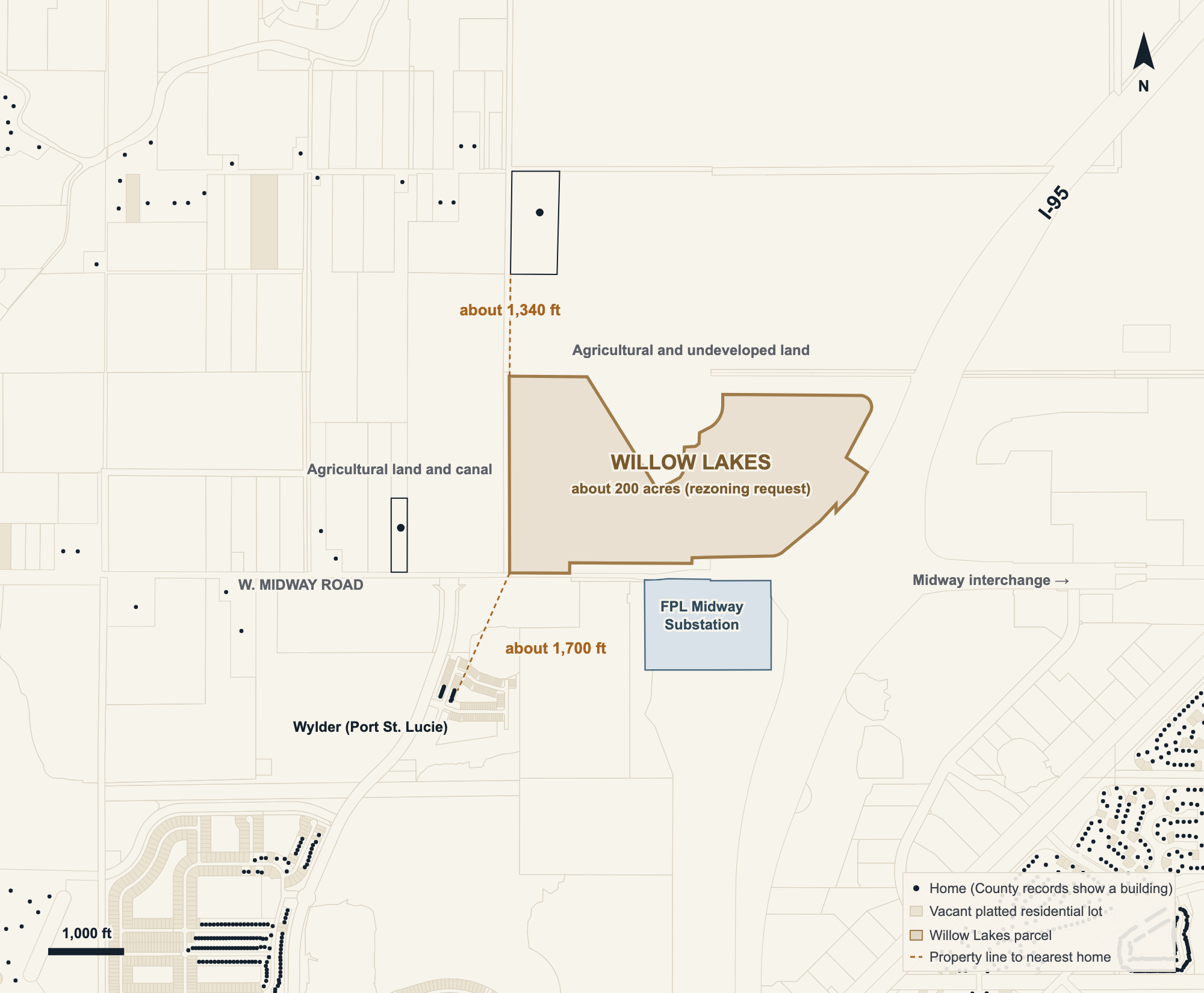
- Interstate access. The site is at the I‑95 interchange on Midway Road. Worker and delivery traffic can reach the site directly from the interchange, and highway traffic sound is already part of the background there.
- High-voltage infrastructure. FPL’s Midway Substation is across Midway Road, about 200 feet from the property line, and two FPL transmission easements cross the property. The 500 kV Levee–Midway line starts at that substation (FDEP). Being close to existing lines shortens the connection a campus needs. FPL determines the capacity it can serve through its large-load process.
- Separation from homes. About 1,340 feet to the nearest rural homesites to the west and about 1,700 feet to the nearest finished home lot in Wylder, measured from the property line. Buildings and equipment would sit inside the property, so they would be farther away. The draft conditions set minimum setbacks of 300 feet for buildings and 400 feet for generators and major mechanical equipment from residential property.
- Surrounding uses. Farmland and undeveloped land lie to the north and west. Large industrial and warehouse uses sit southeast of the interstate.
- An on-site reservoir. A man-made reservoir of about 19.6 acres in the northeast part of the property is the planned water source for cooling, so the campus does not depend on the City’s drinking-water system for it.
- Fiber. The draft conditions require a letter from an independent fiber provider confirming service to the site.
Distance from the Willow Lakes property line to the nearest homes, and the draft minimum setbacks
| Distance | Feet from the property line |
|---|---|
| Draft setback for buildings | 300 |
| Draft setback for generators and mechanical equipment | 400 |
| Nearest rural homesites, west | about 1,340 |
| Nearest finished Wylder home lot | about 1,700 |
| Nearest platted Port St. Lucie homes | about 5,000 |
The draft setbacks are measured from the building or equipment to the residential property line. The home distances are measured from the property line to the home lot line using County parcel data. The measurements are the project team’s own, not City measurements.
Protections
Clear answers to the principal questions
Florida law and FPL’s utility rules are in effect today. The conditions marked “draft” are the applicant’s proposal to the City and apply only if the City adopts them in an approval.
Power costs
Who pays for the power?
The data center pays for what serves it. Florida law requires each large customer, 50 megawatts or more at one site, to bear its own cost for infrastructure and service. That protects residents and businesses from rate increases caused by having a data center online.
How it works
Fla. Stat. §366.043 counts connection, new transmission, new generation and other infrastructure as the customer’s costs. FPL’s approved large-load rate adds a charge for new generation, a monthly minimum bill of at least 70 percent of contracted demand, a minimum 20-year contract with exit charges, credit-based security and payment for the equipment that connects the site. The customer builds and owns its substation. The rule covers the cost of serving this customer. It does not set future rate levels for other households.
Confirmed by
FPL’s system-impact study and service agreements, which set the load and costs before service begins, and the Public Service Commission, which approved the rate and is reviewing FPL’s October 1, 2026 filing under the new law.
Read more
Water
What about water?
Cooling is planned to run on the property’s own reservoir in a closed loop, and Florida now requires a public review before a large data center can use water.
How it works
In a closed loop, the same water circulates through the cooling system, and Loudoun County reports that modern closed-loop systems lose 0 to 5 percent of cooling water to evaporation. The applicant’s preliminary engineering assumes this design with the 19.6-acre reservoir as the source. Fla. Stat. §373.262 bars a water allocation for a data center of 50 megawatts or more if it would harm water resources or conflict with local zoning, and at 100,000 gallons a day or more it requires disclosure of all sources, amounts and losses, a conservation plan and a public hearing. The water district must require reclaimed water when it is available and feasible. The draft conditions add a cooling-water plan and periodic testing, and prohibit or cap routine use of municipal drinking water for cooling.
Confirmed by
Engineering sets the size of the loop and the water balance: how much water is withdrawn, evaporated, replaced and returned. The South Florida Water Management District then decides what amounts to permit, after a hearing, before the water is used.
Read more
Loudoun County on water · How much water could Willow Lakes use?
Sound & lighting
What about sound and lighting?
Sound is managed with distance, equipment placement and enclosures, and measured against limits written into the approval. I‑95 already contributes continuous traffic sound at the site.
How it works
The draft conditions set minimum setbacks of 300 feet for buildings and 400 feet for generators and major mechanical equipment from residential property, and 500 feet from schools, child care, hospitals and nursing homes. They cap sound at the property line and at residential boundaries in dBA and dBC, with separate night limits, and limit routine generator testing to weekdays from 10 a.m. to 4 p.m. Buildings are limited to 65 feet, equipment is screened, and light at the property line is capped at 0.5 footcandle, which matches the City’s existing limit. A landscape buffer is designed to be opaque year-round within three growing seasons. The sound limits themselves are still to be set.
Confirmed by
A sound study with baseline measurements taken on site, including highway sound, and a model of normal operation and generator testing. The draft requires it with the application, the City’s acoustical consultant reviews it, and testing continues after the campus opens.
Read more
The draft conditions · Loudoun County on noise · How is sound controlled?
Traffic
What about traffic?
Once operating, the proposed uses are estimated to generate fewer daily trips than the mixed-use village already approved for this property. Construction is the busiest period.
How it works
The applicant’s traffic consultant estimates 22,920 net new daily trips for the proposed uses, 38 percent fewer than the 37,297 the approved Planned Development would generate. The campus has a small workforce, and the site is reached from the interstate interchange. The draft conditions require a construction management plan covering work hours, haul routes, worker parking, dust, noise and road protection.
Confirmed by
An updated traffic analysis. The St. Lucie Transportation Planning Organization has asked for one that includes nearby approved projects, and St. Lucie County Public Works has asked for a third-party review. The City reviews the construction plan with the site plan.
Read more
Enforceable conditions
Can the City make the conditions stick?
Yes. Florida preserves the City’s authority over land use for data centers, and conditions become part of the approval.
How it works
Fla. Stat. §163.326 says local governments keep their planning and land-development authority over data centers and other large-load customers. The draft conditions set a maximum development envelope up front (building area, height, electric load, on-site generation, cooling capacity and water demand), require studies at each stage, and keep monitoring records for five years. A draft covenant would limit the industrial acreage to data-center use for 50 years. Once signed and recorded, the City can enforce it, and only the City Commission can change it at a public hearing.
Confirmed by
The City Commission, which adopts the conditions in the approval, and City staff and consultants, who check them at conditional use, final site plan, building permit and operation.
Read more
The draft conditions in full · Can Fort Pierce impose conditions?
Neighbors have also asked about wildlife, stormwater, safety, property values and process. Those answers are in the questions residents are asking and the FAQ.
Next steps
What happens next, and how to take part
Sept. 17, 2026
Application tabled
The applicant asked the Planning Board to table the rezoning, and the Board agreed.
Date not set
City Commission discussion
The Planning Board recommended the Commission discuss how data centers fit the zoning code. Staff is researching the question.
If the application returns
Public hearings
New notice, a Planning Board recommendation, then a City Commission decision.
If rezoning is approved
Design and permits
Conditional use, final site plan, building permits, and utility, water and environmental approvals.
To follow the process, read the City’s agendas and ask the Planning Department to notify you. The Status & Documents page lists the contacts and the full record.


Support a transformational economic opportunity for Fort Pierce.
Willow Lakes combines a site with existing transmission and interstate access, state rules for how large data centers pay for power and use water, and an approval process that lets the City write enforceable conditions before anything is built. Fort Pierce can pursue a major investment and strong standards together.

